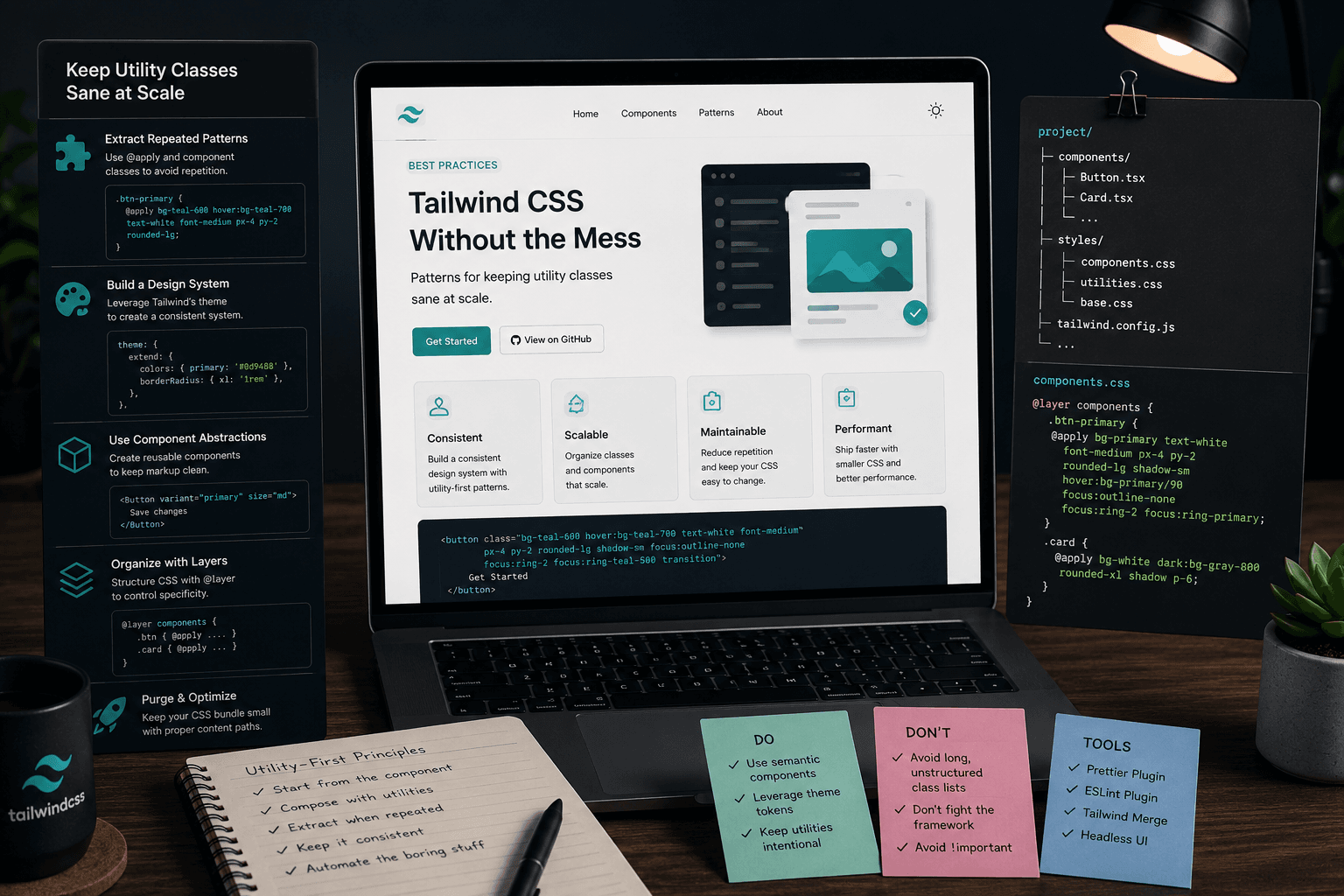
Tailwind CSS Without the Mess: Patterns for Keeping Utility Classes Sane at Scale
Tailwind gets blamed for messy markup more often than it deserves. Most of the mess comes from missing conventions, not from utility classes themselves. A few habits, applied consistently, keep a large Tailwind codebase as readable as a small one.
TL;DR / Written for skimmers
Tailwind intentionally has no built-in way to name a reusable style. The component is the abstraction layer: a Button or Card component absorbs the long className string once, and every place that needs it just renders the component. A long but one-off className is fine to leave inline. A className that gets copied into a second or third place is the actual signal to extract something, whether that is a small component or a shared constant for the class string. Sticking to the default spacing and color scale, instead of constantly reaching for arbitrary values like w-[37px], keeps the interface visually consistent and the classes easier to scan. Grouping related utilities together, layout first, then spacing, then color, then state variants, makes a long className scannable even without a plugin sorting it for you automatically.
Component boundaries are your real abstraction
Tailwind intentionally has no built-in way to name a reusable style. The component is the abstraction layer: a Button or Card component absorbs the long className string once, and every place that needs it just renders the component.
Reaching for @apply to invent a custom class is usually a sign that the real fix is extracting a component, not a new utility shortcut.
When to extract a class string vs a component
A long but one-off className is fine to leave inline. A className that gets copied into a second or third place is the actual signal to extract something, whether that is a small component or a shared constant for the class string.
Treating repetition as the trigger, rather than length alone, keeps the codebase from fragmenting into dozens of tiny one-use components.
Consistent spacing and color scales beat ad hoc values
Sticking to the default spacing and color scale, instead of constantly reaching for arbitrary values like w-[37px], keeps the interface visually consistent and the classes easier to scan.
Arbitrary values are sometimes necessary, especially for pixel-perfect layouts, but they read better when they are the exception in a file rather than the norm.
Reading a long className without losing your place
Grouping related utilities together, layout first, then spacing, then color, then state variants, makes a long className scannable even without a plugin sorting it for you automatically.
A class sorting tool removes the debate entirely and is worth adding early, since it turns an ongoing style argument into a formatting rule nobody has to think about again.